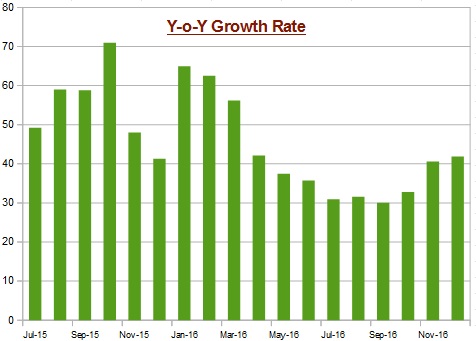
After selling a record number of cars, totalling to 7.9 lakh units, during Q2-FY'17 (i.e. July to September) and recording a healthy Y-o-Y Growth of almost 18%, most of the car makers were looking forward to a buoyant second half of the fiscal. The 14 car brands (excluding the luxury & super-luxury segments), whose sales data I have considered here for my analysis, then followed it up with another new monthly record number of car despatches in October'16 at 2.78 lakh units. Then came the 8th November announcement from our PM about demonetising the Rs.500 & Rs.1000 currency notes, a step which is expected to bring substantial positives for the country & it's citizens over the longer term, but was certainly expected to negatively impact sentiment & business dynamics in various sectors in the near term. The Passenger Car market was not going to be any exception. But the Total Volume Despatch numbers from the 14 car makers in India for the month of November'16 posted a Y-o-Y Growth of 2%, surprising most analysts. But 6 of the 14 brands had reported double-digit % Drop in Sales for November'16. The main Growth drivers were Maruti Suzuki, Volkswagen, Tata Motors & Toyota, who all posted double-digit % increase in despatches.
After a not-so-disappointing November'16, all eyes were on December'16 numbers as the month was going to face not just Demonetisation blues, but also the year-end effect too. Maruti Suzuki & Tata Motors posted a 15+% M-o-M Drop in despatches, though on a Y-o-Y basis it was just about 5% lower for Maruti Suzuki and over 30% increase for Tata Motors. But a smart M-o-M improvement in despatch numbers for manufacturers like Honda, Mahindra, Renault, Volkswagen & Toyota helped restrict the deficit created by fall in numbers from the market leader, to a relatively small number. The Total Despatch volumes for the 14 car makers was just 1.4% lower on a Y-o-Y basis and 6% lower on a M-o-M basis.
The Demonetisation announcement was expected to create near term issues for the automobile industry, not just on the demand side, but also on the supply side. The lack of currency notes in the system was expected to create issues in terms of problems in movement of Goods as well as factory workers needing time off from work to visit the bank and things like that. November & December'16 were expected to have the maximum negative impact with the impact decreasing towards the end of December. If we go by the Despatch numbers for November & December'16 together, the Car industry as a whole has managed to produce & despatch almost the same number of vehicles as it did in last 2 months of 2015. This data point tells us that things were not as bad on the ground as being made out to be by the several News Channels & Economists. Ofcourse we cannot jump to any specific conclusion so soon and we will have to keep an eye on the monthly numbers for another few months before we can arrive at some conclusion with regard to effect of demonetisation on the Car industry. But the numbers from the industry for the first 2 months have been a bit of positive surprise. Hopefully it will stay that way in the coming months too.
 Coming to changes in Market shares for the Car Industry, the table alongside shows the market shares of different manufacturers for Q3-FY'16, Q2-FY'17 and Q3-FY'17 to give us an idea of how things have been moving. India's No.1 Car maker, Maruti Suzuki has seen it's market share drop by about 50 bps Q-o-Q, though it is still higher Y-o-Y. On the other hand, No.2 manufacturer Hyundai's story is exactly opposite. It's market share has shown nearly 140 bps improvement Q-o-Q, but it is still lower on Y-o-Y basis. No.3 player Mahindra has managed to hold on to it's market share Q-o-Q, but is about 110 bps lower on Y-o-Y comparison. At No.4 is Renault-Nissan Alliance, which has seen a near 60 bps Q-o-Q erosion in market share, but is still significantly higher in Y-o-Y comparison. Renault-Nissan Alliance will now be gunning for the No.3 spot in the new year. At No.5 & 6 are Tata Motors and Toyota, both seeing an improvement in market share in Q-o-Q as well as Y-o-Y comparison. But Tata Motors has clearly outperformed Toyota as it was 25 bps behind the latter in Q3-FY'16, while it is now ahead by over 50 bps this year. With 2 or 3 significant new launches lined up for 2017, Tata Motors will look to continue it's march up the market share chart. Honda continues to be the biggest loser in the pack this year with it's market share dropping another 90 bps Q-o-Q. Honda was comfortably at No.4 position in Q3 last fiscal, then dropped to No.5 position in Q2 this fiscal and is now at No.7 position in Q3 this fiscal. The latest launch of BR-V or updated versions of Brio & Amaze don't seem to have helped Honda arrest it's sales slide. It is now preparing to launch the new City model, which should certainly help gain some of the lost market share back. Just like Tata Motors & Toyota, Volkswagen Group too has seen improvement in it's market share both on Y-o-Y basis as well as Q-o-Q basis. But I don't think it will be able to overtake Ford Motor to grab the No.8 position in the near future.
As with any December, most manufacturers had threatened to hike their product prices by 1 to 3% from January'17, but they might have to postpone their price-hike decision depending on the demand for their products in the new year. Generally the manufacturers bring a few updates to their existing models while hiking prices. Let's see if the manufacturers are able to pass on the price hike to the consumers or it is nullified via increase in discounts.
After a not-so-disappointing November'16, all eyes were on December'16 numbers as the month was going to face not just Demonetisation blues, but also the year-end effect too. Maruti Suzuki & Tata Motors posted a 15+% M-o-M Drop in despatches, though on a Y-o-Y basis it was just about 5% lower for Maruti Suzuki and over 30% increase for Tata Motors. But a smart M-o-M improvement in despatch numbers for manufacturers like Honda, Mahindra, Renault, Volkswagen & Toyota helped restrict the deficit created by fall in numbers from the market leader, to a relatively small number. The Total Despatch volumes for the 14 car makers was just 1.4% lower on a Y-o-Y basis and 6% lower on a M-o-M basis.
The Demonetisation announcement was expected to create near term issues for the automobile industry, not just on the demand side, but also on the supply side. The lack of currency notes in the system was expected to create issues in terms of problems in movement of Goods as well as factory workers needing time off from work to visit the bank and things like that. November & December'16 were expected to have the maximum negative impact with the impact decreasing towards the end of December. If we go by the Despatch numbers for November & December'16 together, the Car industry as a whole has managed to produce & despatch almost the same number of vehicles as it did in last 2 months of 2015. This data point tells us that things were not as bad on the ground as being made out to be by the several News Channels & Economists. Ofcourse we cannot jump to any specific conclusion so soon and we will have to keep an eye on the monthly numbers for another few months before we can arrive at some conclusion with regard to effect of demonetisation on the Car industry. But the numbers from the industry for the first 2 months have been a bit of positive surprise. Hopefully it will stay that way in the coming months too.
As with any December, most manufacturers had threatened to hike their product prices by 1 to 3% from January'17, but they might have to postpone their price-hike decision depending on the demand for their products in the new year. Generally the manufacturers bring a few updates to their existing models while hiking prices. Let's see if the manufacturers are able to pass on the price hike to the consumers or it is nullified via increase in discounts.